
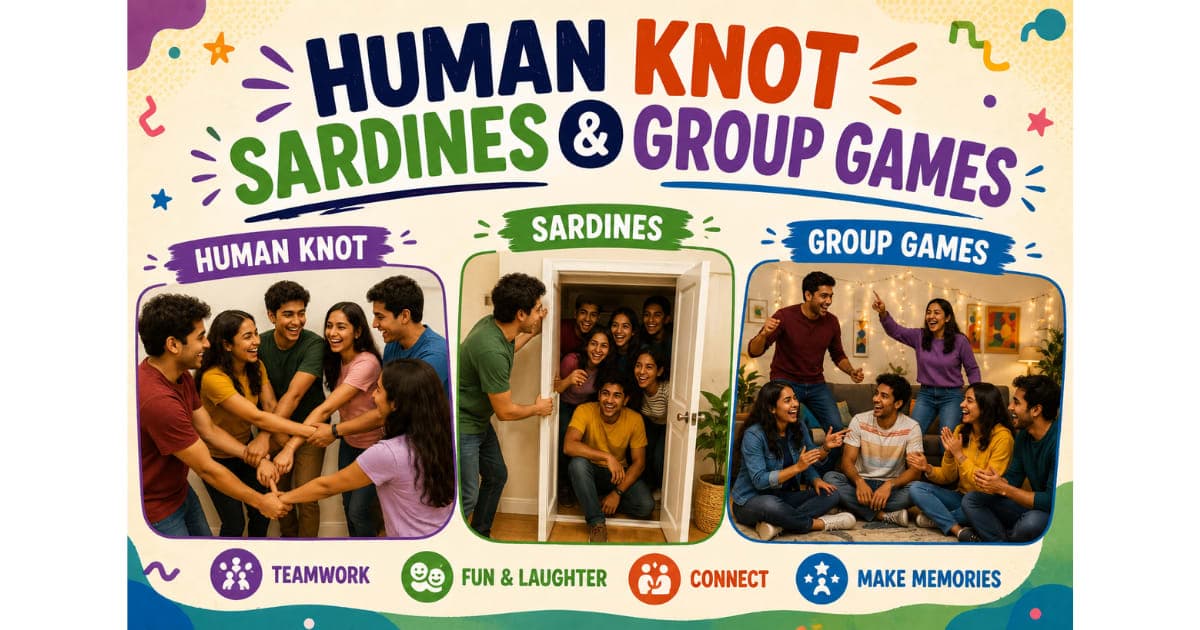
Human Knot, Sardines and More — The Best Large Group Physical Games

May 20, 2026
The Games That Get Everyone Off the Couch
Some of the greatest party games require no equipment, no setup, no reading, and no prior knowledge. Just bodies, space, and willingness to play. Human Knot, Sardines, Duck Duck Goose, and Red Light Green Light represent the purest form of group play — physical, immediate, universal, and joyful.
These games work across generations and cultures precisely because they tap into something fundamentally human — the pleasure of shared physical experience and collective laughter.
Human Knot — The Cooperative Puzzle
What makes it special: Human Knot is the rare party game that is genuinely cooperative. Everyone wins or loses together. The combination of physical closeness, communication challenge, and shared problem-solving creates a bonding experience unlike any competitive game.
What you need: 6 to 20 players and enough floor space for the group to stand in a tight circle.
Complete step-by-step rules:
Step 1: Have all players stand in a circle facing inward, standing close enough to reach across to others.
Step 2: Everyone extends both arms into the center of the circle. Each person grabs the hand of two different people — not the person immediately to their left or right and not both hands of the same person.
Step 3: Once everyone is connected the group must untangle themselves back into a perfect circle without releasing any hands at any point.
Step 4: Players can move over and under arms, rotate their wrists, and step through gaps but cannot let go of hands at any point.
Step 5: The game is complete when the group is standing in one circle (or two circles if the knot splits — this is a valid outcome) with no crossed arms.
Time limit: Set a 10-minute time limit for added pressure. If the group untangles within the time they win. If not they face a group challenge or simply celebrate the attempt.
Human Knot Strategies and Tips
Communication is everything. The biggest mistake groups make is everyone trying to move at once without coordinating. Designate one person as the director early. They do not move but instead observe the knot from outside and give instructions to specific people about which way to step or turn.
Small movements first. Before any big movements assess the knot by gently pulling different hands to understand the structure. Rushing into big movements creates tighter tangles.
Step through do not pull through. When someone needs to pass through a gap they should step through carefully and slowly rather than pulling their hands through at arm height. Lower body passes are usually easier than upper body passes.
Race format for large groups: With 16 or more players split into two groups and race to untangle first. The competitive element creates urgency and generates excellent spectator entertainment as both groups take completely different approaches to the same problem.
Celebrate partial success. Sometimes a knot splits into two circles instead of one. This is a legitimate and impressive outcome. Celebrate it rather than treating it as failure.
Sardines — The Reverse Hide and Seek
Why Sardines beats regular Hide and Seek: In regular Hide and Seek one person hides and everyone searches. In Sardines one person hides and everyone searches individually, but when you find the hidden person you secretly join them in hiding. As more people find the hiding spot the group grows until one person is left searching alone — they become the next hider. This reversal creates a completely different social dynamic that is genuinely funnier and more engaging than the original.
What you need: 5 to 20 players, a space with multiple hiding options, and enough rooms or outdoor space for actual hiding.
Complete rules:
Step 1: Choose one player to be the first hider. Everyone else turns away and counts slowly to 30 to give the hider time to find a spot.
Step 2: When the count reaches 30 all seekers spread out and begin searching individually. Players must not communicate with each other about where they are searching.
Step 3: When a player finds the hider they must act natural and casually squeeze in to hide in the same spot without being seen by other seekers. The giggling challenge of fitting multiple people into increasingly small hiding spots is what makes Sardines so delightful.
Step 4: As more players find the hiding spot the space becomes more crowded and maintaining concealment becomes harder. The sound of suppressed laughter is usually what gives the location away.
Step 5: The last player to find the group is the next hider. They also usually endure some gentle teasing for being the last one.
Great Hiding Spots for Sardines
The best Sardines hiding spots share specific qualities — they are not immediately obvious but can realistically fit multiple people once found. Behind a cluster of furniture pushed together. Inside a closet with clothes hanging to provide some cover. Behind a large couch facing a wall. In a bathroom with the lights off. Under a large bed. In a corner hidden by an open door. Behind a large curtain in a corner.
For outdoor Sardines large bushes, garden sheds, the space behind a parked car, and dense vegetation create excellent multi-person hiding spots.
Duck Duck Goose — Complete Guide
Players: 6 to 30. Works beautifully across all ages.
Setup: Players sit in a circle facing inward. One player is designated It and stands outside the circle.
Complete gameplay:
Step 1: It walks slowly around the outside of the circle tapping each seated player gently on the head saying Duck with each tap. Duck. Duck. Duck. Duck.
Step 2: At a moment of It's choosing they tap a player and say Goose instead of Duck.
Step 3: The Goose immediately jumps up and chases It around the circle trying to tag them before It can reach the Goose's empty seat and sit down.
Step 4: If It makes it to the empty seat without being tagged they are safe. The Goose is now It and the game continues.
Step 5: If the Goose tags It before they reach the seat It must sit in the center of the circle (the mush pot). The Goose becomes the new It. It can escape the mush pot when another player is tagged and sent there instead.
Red Light Green Light — Complete Guide
Players: 4 to 30. Works beautifully both indoors with space and outdoors.
Setup: Mark a start line and a finish line 20 to 30 feet apart. One player is designated the traffic light and stands at the finish line facing away from the group. All other players stand at the start line.
Complete gameplay:
Step 1: The traffic light faces away from the group and calls Green Light. All players immediately move forward toward the finish line as quickly as possible.
Step 2: At any moment the traffic light turns around and calls Red Light simultaneously. All players must freeze completely the instant they hear Red Light.
Step 3: The traffic light scans the group. Any player caught still moving after Red Light is called must return to the start line.
Step 4: The traffic light turns back around and calls Green Light again. Players continue moving forward.
Step 5: The first player to reach and touch the traffic light wins the round and becomes the new traffic light.
Competitive tip: Keep scores across rounds. The player who wins the most rounds or wins fastest overall is the champion of the evening.
Creating a Complete Physical Games Evening
These four games work together beautifully as a complete physical game night program:
Opening warm-up (15 minutes): Start with Red Light Green Light. It requires no explanation beyond the basics and gets everyone moving immediately. The quick competitive bursts wake people up and set an active tone.
Team bonding activity (20 minutes): Move to Human Knot. The cooperative challenge creates team identity and physical proximity that makes subsequent games feel more connected and fun.
Individual exploration (20 minutes): Sardines in a different area of the venue. The quieter, more mysterious atmosphere of Sardines provides contrast after the energetic warm-up games.
High energy finale (15 minutes): End with Duck Duck Goose or a final Red Light Green Light tournament. The familiar and energetic format sends everyone home on a physical and emotional high.
Why Physical Games Create the Most Powerful Memories
Neuroscience consistently shows that physical experience creates stronger memories than passive observation. When we use our bodies in playful ways with other people we create multi-sensory memories that encode more deeply than sitting experiences. The feeling of the Human Knot finally untangling, the moment of finding 8 people crammed into a closet in Sardines, the desperate sprint in Duck Duck Goose — these physical memories stay with us in ways that sitting games rarely do.
This is the secret power of physical party games. They do not just entertain. They create the kind of shared bodily experience that bonds people at a level that words and strategies cannot reach.