
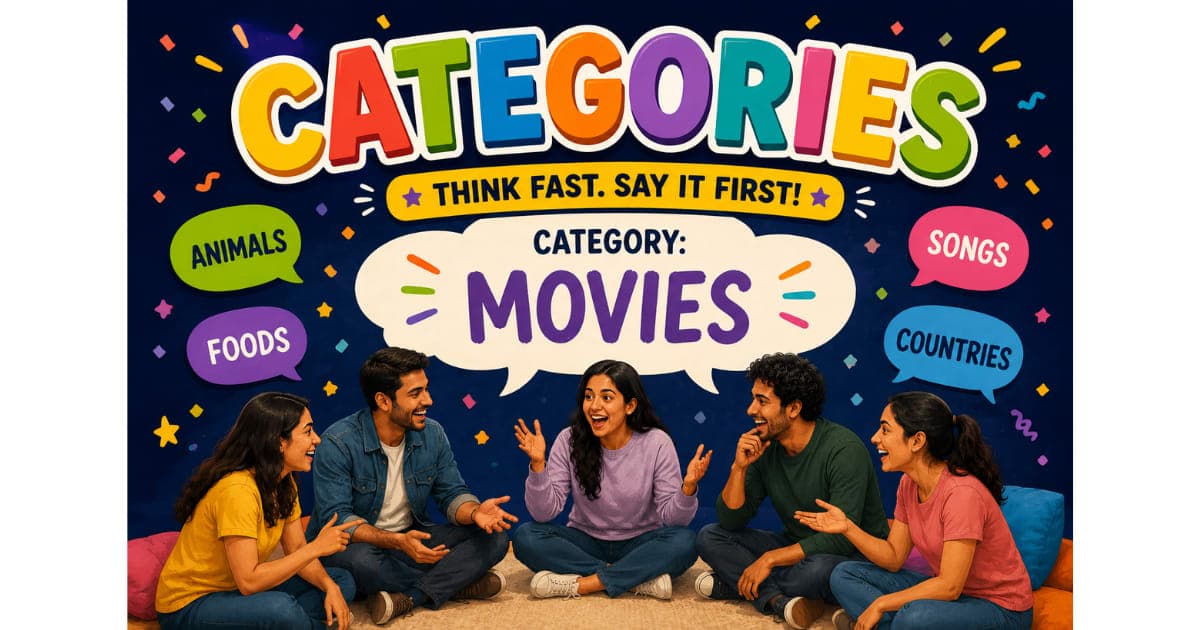
How to Play Categories — The Fast Thinking Party Game Everyone Loves

May 20, 2026
The Fast Thinking Game That Works Everywhere
Categories is one of those games that seems almost too simple when you first hear the rules. You name a category and people take turns saying things that fit. That is it. And yet Categories is one of the most consistently entertaining party games in existence because it combines quick thinking under pressure, knowledge breadth, creativity, and competitive tension in perfect proportions.
The moment of panic when your turn arrives and your mind goes completely blank, the triumph of remembering something obscure that keeps you in the game, the laughter when someone confidently says something that does not fit at all — Categories delivers all of this in a format that requires absolutely nothing except willing participants.
The Complete Rules
Players: 3 to 30 players. Scales beautifully for any group size.
Setup: Players sit in a circle. No equipment needed though having a list of categories prepared in advance keeps the game moving smoothly.
Basic gameplay: One player announces a category. Starting with the player to their left everyone takes turns saying one thing that belongs in that category. Players have 5 seconds to answer. Anyone who hesitates too long, repeats a previous answer, gives an incorrect answer, or cannot think of anything is eliminated. The last player remaining wins that round.
Round rotation: After each round a new player announces the next category. Rotate clockwise so everyone gets a turn to choose.
Tournament format: For longer play run a series of rounds with points awarded for each round won. The player with the most round wins after a set number of rounds wins the tournament.
The Best Categories by Difficulty Level
Easy categories (great for warming up or playing with children): Animals, colors, fruits, vegetables, countries, sports, musical instruments, types of weather, things in a bedroom, things you find at a beach, names that start with a specific letter, cartoon characters, superhero names.
Medium categories (good for mixed groups): Olympic sports, things in a kitchen, car brands, pizza toppings, things that are round, US states, world capitals, types of pasta, board games, things you find in a hospital, movie genres, types of music.
Hard categories (for experienced players and trivia enthusiasts): Noble gases, types of cheese from France, Olympic host cities, Shakespeare plays, things in a specific room in a specific museum, Emmy Award winning shows, ingredients in specific cocktails, bones in the human body.
The Most Fun and Creative Categories
These categories generate the most laughter and unexpected answers:
Things you should never say in specific situations: Things you should never say on a first date. Things you should never say to a police officer. Things you should never say when meeting your partner's parents. These categories require creative thinking and generate genuinely funny answers.
Fictional character categories: Things in Hogwarts. Things in the Marvel universe. Disney princess names. Pixar movie titles. These work especially well for groups with shared pop culture knowledge.
Sensory and descriptive categories: Things that are sticky. Things that make a loud sound. Things that smell bad. Things that feel soft. These categories unlock creative and unexpected answers that pure knowledge categories miss.
Combination categories: Things that are both red and edible. Sports that involve water and a ball. Animals that are bigger than a car and smaller than a house. The intersection of two criteria creates a more challenging and entertaining experience.
Bollywood and Indian Culture Categories
For South Asian households and anyone who loves Bollywood culture these specialized categories create magical multigenerational moments:
Bollywood specific: Shah Rukh Khan movies. Songs from Dilwale Dulhania Le Jayenge. Famous Bollywood dialogues. Indian classical dances. Bollywood movies set in foreign countries. Famous Indian cricketers. Street foods from Mumbai. Types of Indian bread. Indian classical music instruments.
Why these work so well: These categories work across generations in a uniquely powerful way. Grandparents know classic songs and old film references. Parents know 90s and 2000s hits. Young adults know recent blockbusters and memes. The overlapping knowledge creates cross-generational connection that few other topics achieve.
Categories for Educational Settings
Categories is beloved by teachers because it disguises learning as play so effectively:
Geography learning: Countries in South America. Capital cities of European countries. Longest rivers in the world. Countries that border India. States that border California. These categories build geographical knowledge through repetition and competition.
Science categories: Elements on the periodic table. Types of clouds. Names of planets and moons. Types of rocks. Parts of a cell. Animals that are mammals. These categories reinforce science curriculum in an engaging way.
Language and literature: Words that mean happy. Shakespeare plays. Types of poems. Words with silent letters. Authors from the 19th century. These categories build vocabulary and literary knowledge.
Speed Round Variations
30-second speed round: Set a timer for 30 seconds. Players must shout valid answers as fast as possible with no turns — just whoever thinks of something first. Count how many unique valid answers the group generates collectively. Try to beat your own record in subsequent rounds.
Countdown clock pressure: Instead of 5 seconds per player use a visible countdown timer on a phone. Watching the clock tick down creates extra pressure and produces the best spontaneous comedy when someone's mind goes completely blank at 2 seconds.
Category chain: Each new category must be connected to the previous one. If the previous category was Types of Pizza the next must start with something related — Types of Italian Food, Things in a Kitchen, or Things That Are Round. This continuous chain keeps everyone thinking ahead.
Why Categories is a Perfect Warm-Up Game
Categories works brilliantly as the first game of any game night because it requires nothing from players except presence and basic knowledge. It warms up competitive instincts without intimidating newcomers. It gets people laughing quickly. And it can run for exactly as long as needed — three rounds to warm up or thirty rounds as the main event depending on what the evening calls for.
Keep a list of diverse categories ready and Categories becomes one of the most reliable tools in any game night host's toolkit.